
Industry-Ready: Building the Runway for Effective Industry Engagement
Key Takeaways from Our June 17th Coffee Break Webinar
Industry engagement has become a strategic imperative for higher education. As institutions seek to strengthen research partnerships, support workforce development, and drive regional economic impact, the challenge is no longer whether to engage with industry; it's how to do so in a coordinated, institution-wide way.
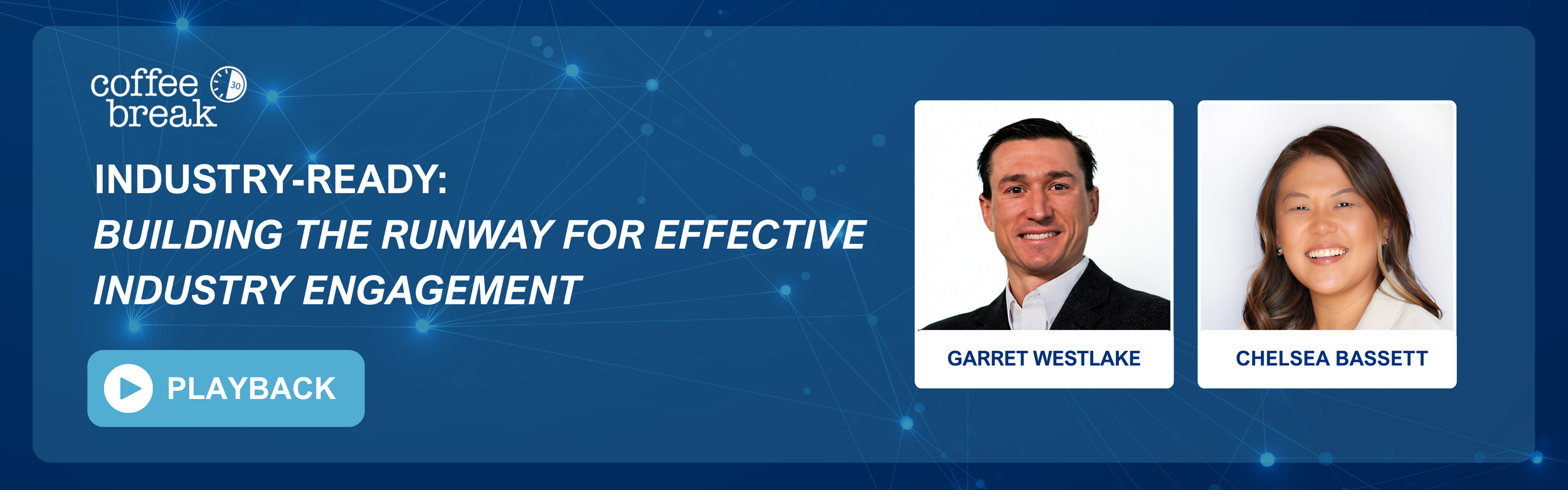
During Academic Analytics' latest Coffee Break, Garret Westlake, Vice Provost for Innovation and Strategic Design at Virginia Commonwealth University (VCU), joined Chelsea Bassett, Senior Product Manager at Academic Analytics, to discuss what it takes to build sustainable approaches to external engagement. Rather than focusing on individual partnerships, the conversation centered on creating the institutional infrastructure that enables industry engagement to flourish.
Here are four key themes from the discussion.
1. Industry engagement is a team sport
One of the biggest barriers to successful industry engagement is organizational fragmentation. Across most institutions, relationships with industry are distributed across research offices, career services, corporate relations, advancement, economic development, individual colleges, and faculty themselves.
As Westlake noted, this often leads to duplicated efforts, inconsistent communication, and missed opportunities.
Instead of viewing industry engagement as the responsibility of a single office, institutions should focus on creating shared ownership. Transparency around priorities, regular communication across units, and a common understanding of institutional goals all help ensure that external partners experience a coordinated institution rather than a collection of disconnected offices.
2. Build systems—not just partnerships
Successful industry engagement depends on more than cultivating individual relationships. Institutions also need systems and processes that make collaboration easier for both faculty and external partners.
At VCU, this has meant rethinking internal processes to reduce friction. Rather than requiring companies to navigate separate agreements with multiple departments, the university has explored institution-level approaches, including master service agreements, that simplify collaboration across research, student engagement, and innovation activities.
The goal is to remove administrative barriers so faculty and industry partners can focus on the work itself.
3. Use data to start better conversations
Many universities already collect information about industry partnerships, but that information often exists in separate systems across campus.
Westlake emphasized that the value of data isn't simply reporting activity. Instead, it provides a starting point for conversations with deans, department leaders, and faculty.
By understanding where collaborations already exist, institutions can identify successful models, uncover gaps, and ask more informed questions:
Which colleges have particularly strong industry relationships?
Where are partnerships growing?
Which units may need additional support?
Are there opportunities to coordinate existing relationships across campus?
Rather than serving as a scorecard, institutional data becomes a catalyst for strategic planning and collaboration.
4. Design with faculty, not for faculty
Faculty play a central role in industry engagement, particularly through research collaborations, consulting, and innovation activities. But increasing participation requires understanding the experiences of faculty already engaged and those encountering barriers.
Westlake described using institutional data to identify highly engaged faculty members, learn what's working well, and then explore why participation varies across disciplines or departments.
Instead of launching one-size-fits-all initiatives, institutions can work alongside faculty to design supports that reflect their needs, reducing administrative burden while expanding opportunities for meaningful engagement.
Building the runway
Strong industry partnerships rarely happen by chance. They emerge when institutions intentionally align people, processes, and data around shared strategic goals.
As colleges and universities continue to prioritize research growth, workforce development, and regional impact, building the internal infrastructure for collaboration becomes just as important as cultivating external relationships.
The conversation reinforced a central theme: becoming "industry-ready" isn't about creating another office or launching another initiative. It's about building an institutional culture where collaboration is coordinated, informed by evidence, and designed to make engagement easier for everyone involved.
Missed the session? Email marketing@academicanalytics.com and request the full recording to hear additional insights from Garret Westlake on creating sustainable, institution-wide approaches to industry engagement.